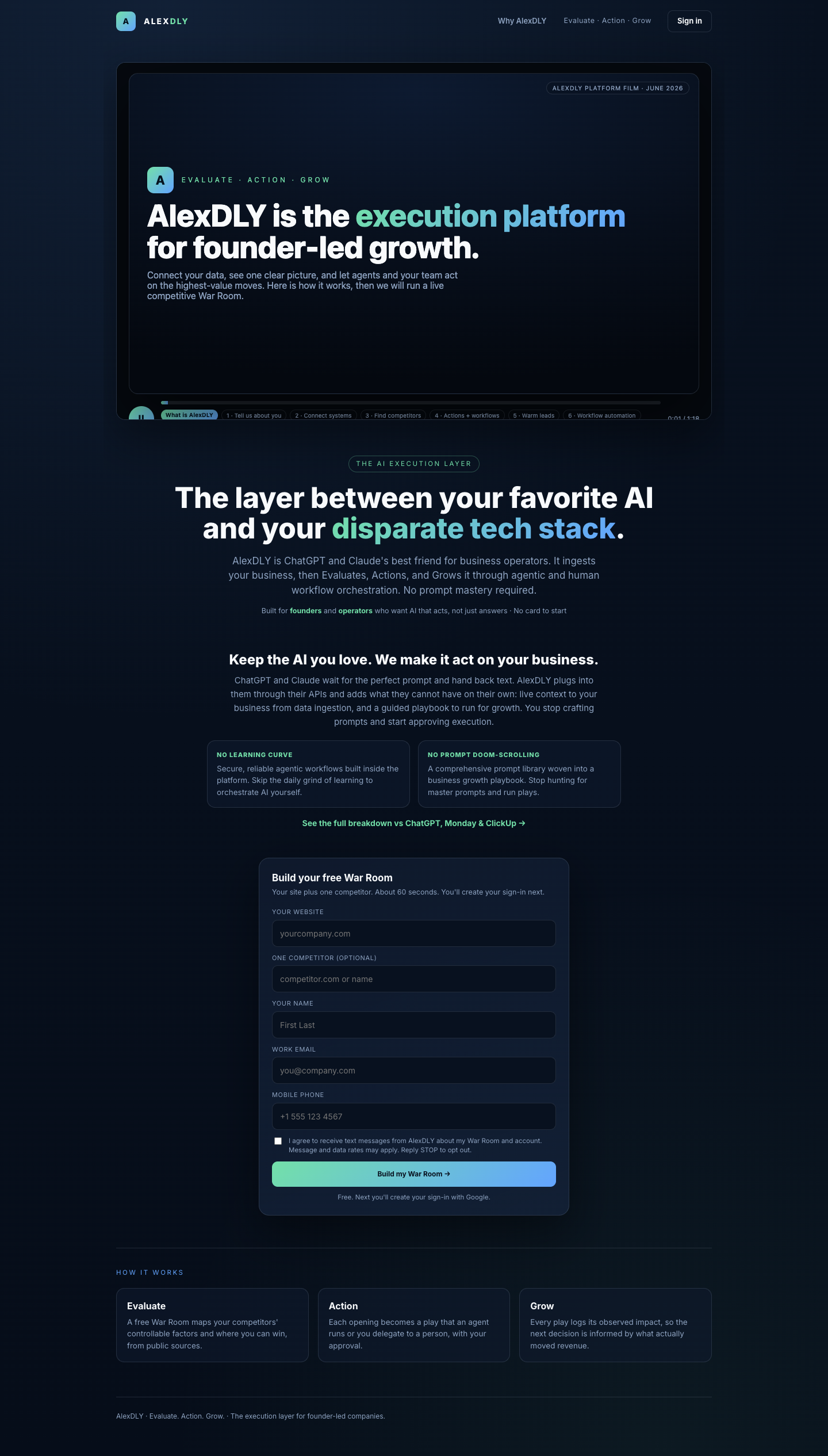
The operating system for founder-led growth.
AlexDLY turns disconnected business context into one guided operating layer: ingest data, build durable memory, route work through agents, and give operators a command center that actually drives action.
Most AI deployments die in the gap between interesting and operational.
The current state
- Disconnected systems create shallow, low-confidence AI outputs.
- Teams get novelty, not a repeatable operating model.
- Leaders cannot see what the agents are doing or why.
The AlexDLY bet
- Bring your own models.
- AlexDLY owns the memory, workflow, and command layer.
- That is where the long-term stickiness lives.
Clients bring the models. AlexDLY provides the machine.
1. Ingest
Connect marketing, sales, operations, docs, notes, exports, and systems of record into one governed context layer.
2. Organize
Map the business into domains, workflows, priorities, decisions, people, and operating constraints.
3. Execute
Let agents act inside visible workflows with approvals, logs, handoffs, and measurable outcomes.
Immediate value, not a science project
Within the first session, the client should get a live business map, a guided memory structure, one real workflow, and a command-center view worth returning to.
Obsidian becomes the human-readable business brain.
What goes into memory
- Decisions and rationale
- People, accounts, relationships
- Projects and active initiatives
- SOPs, playbooks, and recurring workflows
- Meeting notes, lessons learned, and operating context
Design principle
Narrative memory belongs in Obsidian. Transactional state belongs in the runtime database. That split keeps the product transparent, trustworthy, and usable by humans.
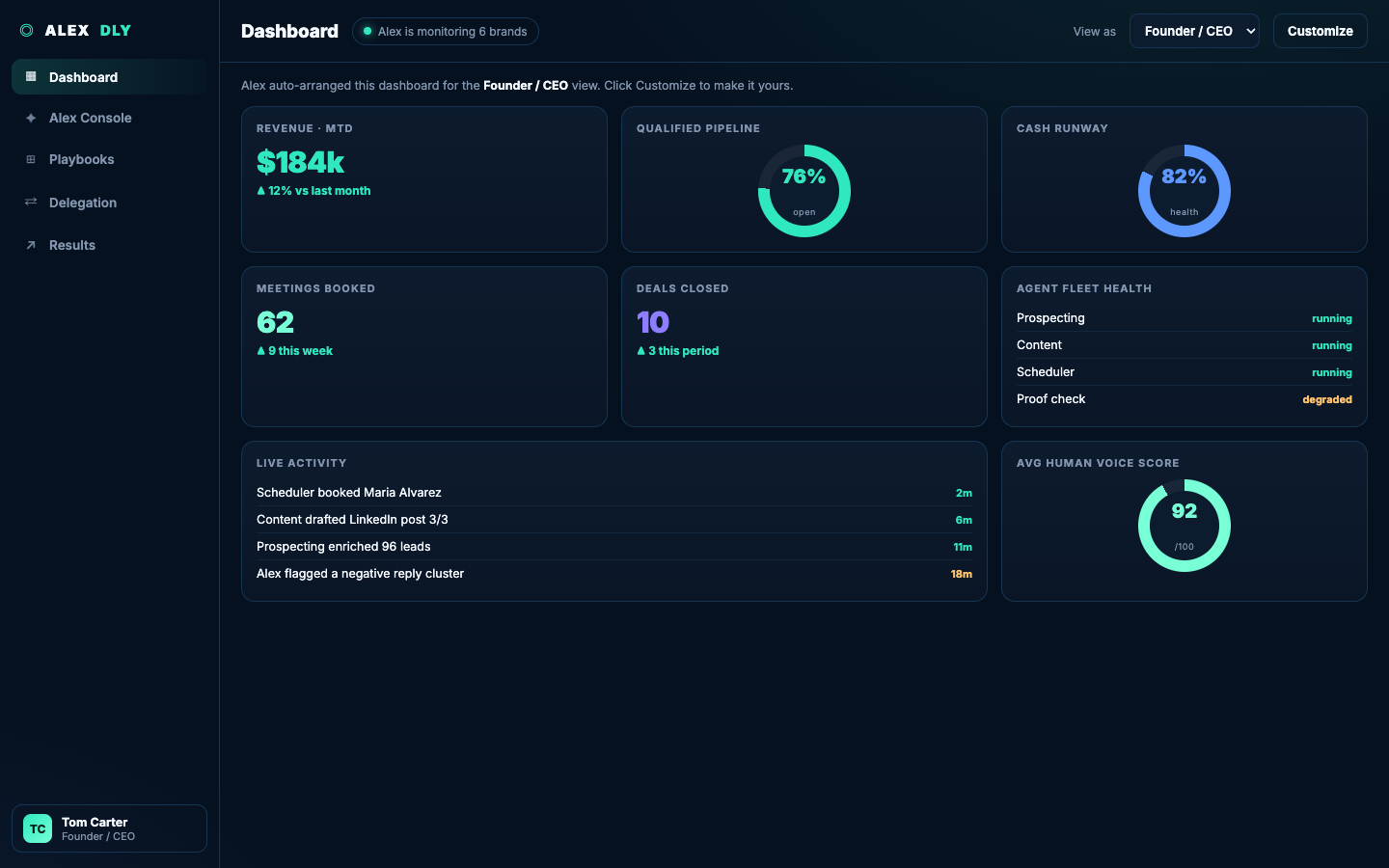
A user-friendly console that feels like an operating cockpit, not an AI toy.
The command center should show what matters now: performance, agent health, live activity, approvals, workflow status, and role-specific views for founder, sales, marketing, finance, and operations.
Agents should execute inside visible playbooks.
Example workflow: outbound to booked meeting
Governed
Approvals, constraints, and write-backs keep the system safe and auditable.
Measurable
Every workflow creates an outcome trail: what happened, who approved it, and what moved.
Composable
Start with one painful lane, then expand into a library of reusable operating playbooks.
Immediate value first. Compounding value after.
First session win
- Connect core data sources
- Generate the business map
- Stand up the Obsidian vault structure
- Launch one live workflow
- Open a real command-center screen
Why clients stay
- Memory accumulation
- Workflow accumulation
- Decision history
- Agent performance history
- Cross-functional operating context
Core UX rule
No black-box chaos. Human-readable memory, clean operator views, and guided setup keep the system from feeling clunky while still creating long-term lock-in.
Price the operating leverage, not the tokens.
SMB setup for ingestion mapping, memory architecture, first workflows, and command-center configuration.
Memory sync, orchestration, workflow governance, dashboards, and multi-function command-center value.
Ongoing workflow tuning, prompt optimization, ingest expansion, and operator support.
BYOK lowers friction
Clients bring Claude and ChatGPT keys, which reduces margin anxiety and avoids token-markup objections.
High-margin core
The operating system layer should carry the margin. Tokens are pass-through, not the business model.
Value-based packaging
Price by connected functions, active workflows, and support depth, not by agents or token counts.
AlexDLY is the layer between your favorite AI and your disparate tech stack.
Connect the business. Build the memory. See the work. Guide the machine. That is how AI becomes an operating system instead of another app to manage.
The wedge
Immediate value through one live workflow and a visible command center.
The moat
Compounding business memory, decision history, and workflow intelligence.